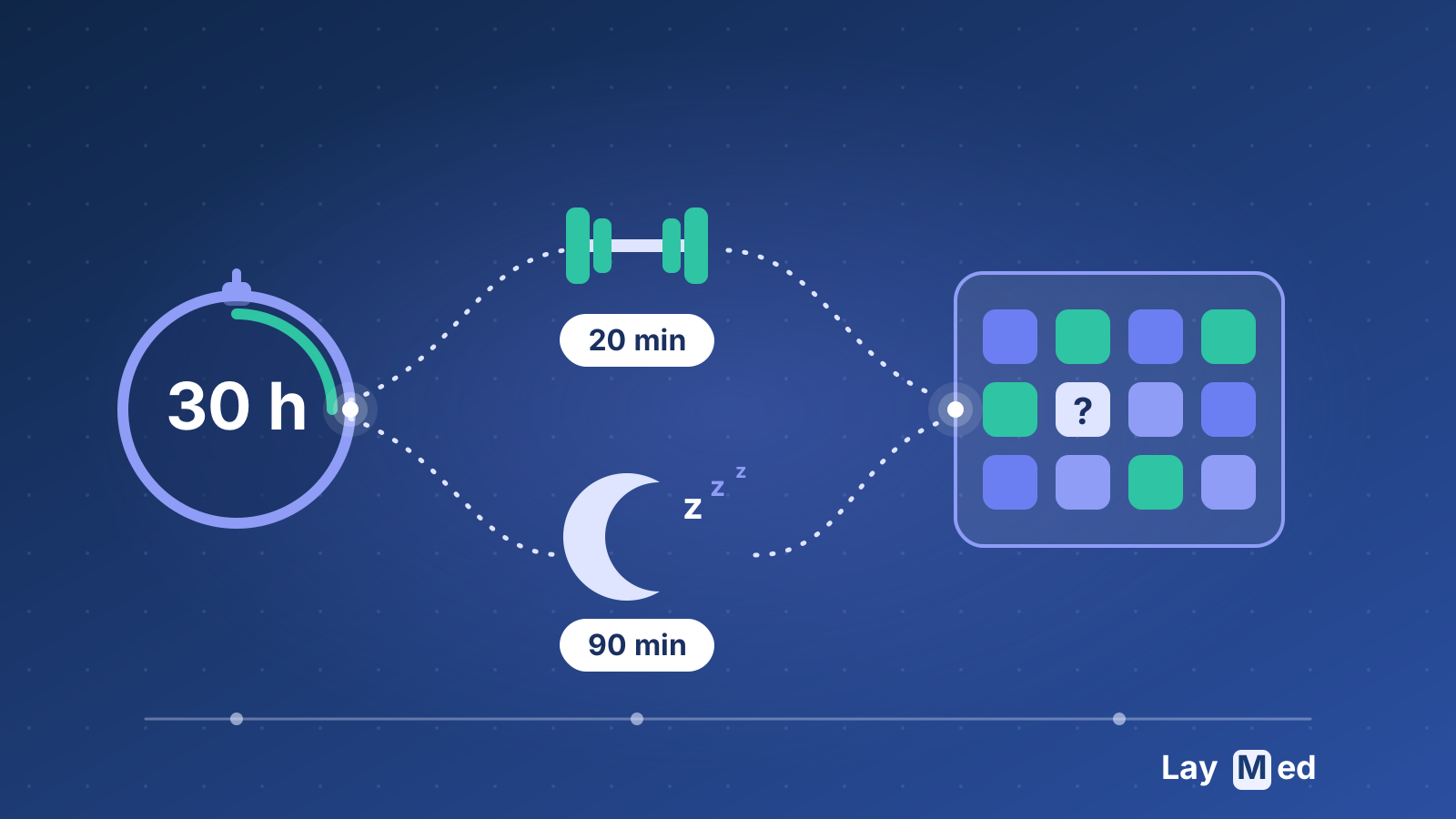
A 20-Minute Workout Protected Memory After 30 Hours Without Sleep as Well as a 90-Minute Nap
Original study: Protecting episodic memory after sleep loss: Similar benefits of exercise and naps via distinct neural contributions
PNAS August 7, 2026
What the researchers wanted to know
After a full night without sleep, does a short workout or a nap help people remember new things better than doing neither?
Why it matters
Between 20% and 40% of adults do not sleep enough, and millions work night shifts in jobs where mistakes are costly. Going without sleep makes it harder to store new memories. Most people cannot simply stop and sleep, so quick fixes that work would be useful.
To remember something later, your brain first has to take it in properly. This first step works badly when you are short on sleep, so less of what you see and hear sticks.
A nap is the obvious fix because it gives the brain some of the sleep it is missing. Exercise works differently. A single hard workout is known to sharpen thinking for a while afterwards in well-rested people. Nobody had tested whether it does the same for memory after a night with no sleep.
54 healthy adults aged 18 to 35 stayed awake for 30 hours in a lab, watched by staff. They were then randomly split into three groups:
- Workout: 20 minutes on an exercise bike at 80% of their maximum heart rate, with a 3-minute warm-up and cool-down.
- Nap: a 90-minute chance to sleep in a quiet room.
- Neither: 20 minutes sitting on the bike without pedaling.
Thirty minutes later, everyone looked at 150 pictures while a cap recorded their brain activity. They were not told there would be a memory test.
Three days later they were shown 225 pictures, the 150 old ones mixed with 75 new ones, and said which they had seen before.
Pictures remembered 3 days later
People who worked out or napped remembered about a fifth more pictures than people who did neither, and the workout and the nap did equally well.
- Neither: recognized 46% of the pictures they had seen
- Workout: 56%
- Nap: 57%
The workout and the nap seemed to help in different ways. The nap made people feel much less tired and calmed the slow brain waves that build up with sleep loss, as if the brain had been partly recharged. The workout did not change how tired people felt. Instead, their brains responded more strongly to each picture, as if they were using what energy they had left more efficiently.
Other findings:
- The workout did not make people more tired than sitting still.
- People in all three groups wrongly said they had seen some new pictures (17% to 24% of them), with no clear difference between groups.
- A second memory score that takes those wrong answers into account did not differ clearly between the groups.
Conclusion
After 30 hours without sleep, a 20-minute workout or a 90-minute nap both helped people remember about a fifth more of what they saw next.
Therefore
A short workout or a nap may help people who must keep working after a sleepless night, such as shift workers, hold on to new information. The researchers stress that neither replaces sleep.
How much can you trust this study?
Two studies can say the same thing and deserve very different amounts of trust. LayMed scores every study out of 100 on:
- Study design
- Bias Control & Transparency
- Size and precision
- Measurement
LayMed Plus members see the Study Quality score for every study, with the reason behind each part.
Get LayMed Plus$7.99 a month or $79 a year
How far does this apply to you personally?
A study can earn a high quality score and still not apply well to you. How much its results carry over to you can change a lot depending on your sex, age, race or ethnicity, body weight, genes, hormones, blood pressure and resting heart rate, health conditions, medications, activity level, training experience, diet, sleep, smoking and drinking, job and gut bacteria.
Hover over or tap any of these to see a real study where it changed the results.
LayMed Plus members get a personal Relevance score for every study. It weighs all of these factors to estimate how well the results apply to you and your life.
Get LayMed Plus$7.99 a month or $79 a year
Important new studies, explained in plain English, sent straight to your inbox.
Almost done. Please check your email for a confirmation sent from "laymed@dr-gains.com".
Last checked against the source: November 20, 2026
Update November 20, 2026: Written to the LayMed article standard from the full published paper.
LayMed articles are plain-English summaries of published research, written for education. They are not medical advice. Always read the original study and talk to a qualified professional about your own situation.