
People Regained 60% of the Weight They Lost Within a Year of Stopping Ozempic-Type Drugs in a Review of 48 Studies
Original study: Trajectory of weight regain after cessation of GLP-1 receptor agonists: a systematic review and nonlinear meta-regression
eClinicalMedicine March 4, 2026
What the researchers wanted to know
After people stop taking a GLP-1 weight-loss drug such as semaglutide or tirzepatide, how much of the lost weight comes back, and how quickly?
Why it matters
These drugs produce large weight loss, but many people stop taking them because of cost or side effects. Trials had shown that weight returns after stopping. What nobody had worked out was the shape of that regain over time: how fast it happens, and whether it stops before all the weight is back.
GLP-1 drugs copy a gut hormone that reduces appetite. The main ones are liraglutide (Saxenda), semaglutide (Ozempic, Wegovy) and tirzepatide (Mounjaro, Zepbound). The newer two produce the most weight loss.
The drugs only work while you take them. When they are stopped, appetite returns to what it was before, and the body tends to drift back toward its earlier weight.
The largest trials followed people for up to one year after their last dose. No large trial has followed them for longer.
The researchers searched five research databases up to August 2025 for any study that reported body weight in adults with overweight or obesity after they stopped a GLP-1 drug.
- 48 studies qualified: 36 trials where people were randomly assigned to treatments, and 12 other studies.
- People had taken the drugs for 10 to 104 weeks and were followed for 4 to 104 weeks after stopping.
To draw the overall curve of weight regain, the researchers combined the six large trials that tracked weight for up to a year after stopping and in which people had lost at least 3 kg. Together these included 3,236 people who had taken semaglutide, tirzepatide or liraglutide.
Regain was measured as a share of the weight each group had lost on the drug. The researchers then used the curve to estimate what happens beyond one year.
Share of lost weight regained after stopping
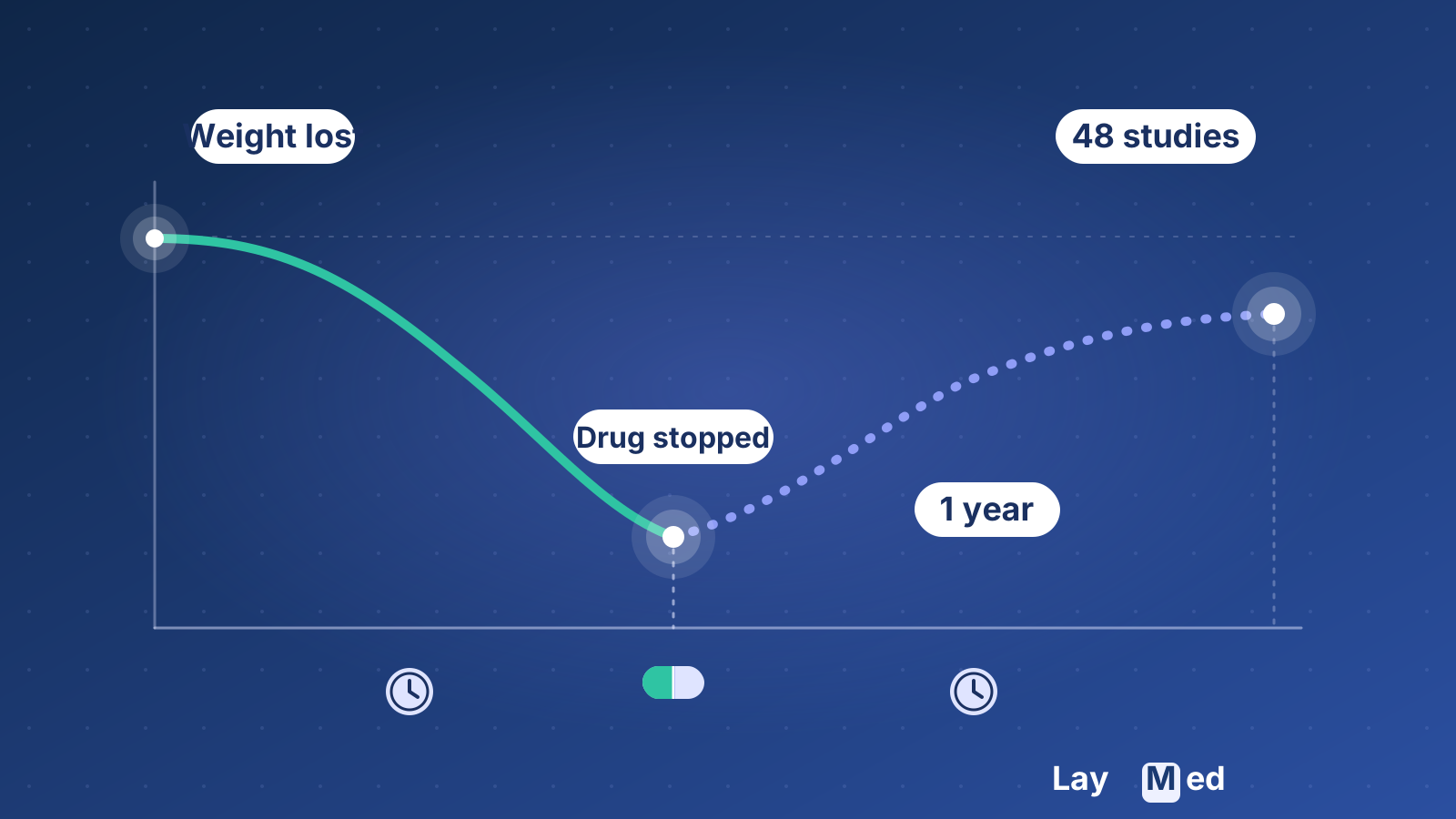
Weight came back quickly at first and then slowed, with about 60% of the lost weight regained within a year of stopping.
- Half of the eventual regain happened in the first 23 weeks.
- At 1 year: people had regained 60% of the weight they had lost.
- Beyond 1 year (an estimate): regain was projected to level off at about 75% of the weight lost, somewhere between 69% and 82%. That would leave people keeping off about a quarter of what they lost.
- Regain slowed and began to flatten at around 60 weeks.
The pattern looked much the same for liraglutide, semaglutide and tirzepatide.
Across the wider set of 48 studies, almost every study saw weight return after stopping. Twelve weeks after the last dose, the amount regained ranged widely, from about 10% to 80% of the weight lost.
Most of the studies were rated as having a moderate risk of bias.
Conclusion
After stopping a GLP-1 weight-loss drug, people regained about 60% of the lost weight within a year, with regain slowing over time and appearing to level off before all of the weight returned.
Therefore
Doctors and patients should expect weight regain after stopping these drugs and may want to plan ways to limit it, while some of the weight-loss benefit may last.
How much can you trust this study?
Two studies can say the same thing and deserve very different amounts of trust. LayMed scores every study out of 100 on:
- Study design
- Bias Control & Transparency
- Size and precision
- Measurement
LayMed Plus members see the Study Quality score for every study, with the reason behind each part.
Get LayMed Plus$7.99 a month or $79 a year
How far does this apply to you personally?
A study can earn a high quality score and still not apply well to you. How much its results carry over to you can change a lot depending on your sex, age, race or ethnicity, body weight, genes, hormones, blood pressure and resting heart rate, health conditions, medications, activity level, training experience, diet, sleep, smoking and drinking, job and gut bacteria.
Hover over or tap any of these to see a real study where it changed the results.
LayMed Plus members get a personal Relevance score for every study. It weighs all of these factors to estimate how well the results apply to you and your life.
Get LayMed Plus$7.99 a month or $79 a year
Important new studies, explained in plain English, sent straight to your inbox.
Almost done. Please check your email for a confirmation sent from "laymed@dr-gains.com".
Last checked against the source: November 20, 2026
Update November 20, 2026: Written to the LayMed article standard from the full published paper.
LayMed articles are plain-English summaries of published research, written for education. They are not medical advice. Always read the original study and talk to a qualified professional about your own situation.