
Faster Walkers Lived Longer in a 12-Year Study of 4,067 Adults, Whether Pace Was Timed in a Clinic or Tracked in Daily Life
Original study: Clinical Walking Speed, Free-Living Walking Cadence, and All-Cause Mortality
JAMA Network Open October 23, 2026
What the researchers wanted to know
Is a person's walking pace in everyday life, measured by a wrist tracker, linked to how long they live as strongly as their walking speed timed in a clinic?
Why it matters
Doctors have long used a short timed walk as a quick sign of overall health in older adults. But a walk across a clinic room is only a snapshot. Wrist trackers can now record how people walk all day, every day, and it was not known whether that tells us as much.
There are two ways to measure how fast someone walks:
- A clinic test: a nurse times you walking a short marked distance at your normal pace. The result is a speed, in meters per second.
- A wrist tracker: the device counts how many steps you take each minute while you are walking in daily life. This is your step rate.
Walking pace reflects how well the heart, lungs, muscles, joints and nervous system are working together, which is why it is often called a sign of overall health.
Earlier studies had shown that people who take more steps a day tend to live longer.
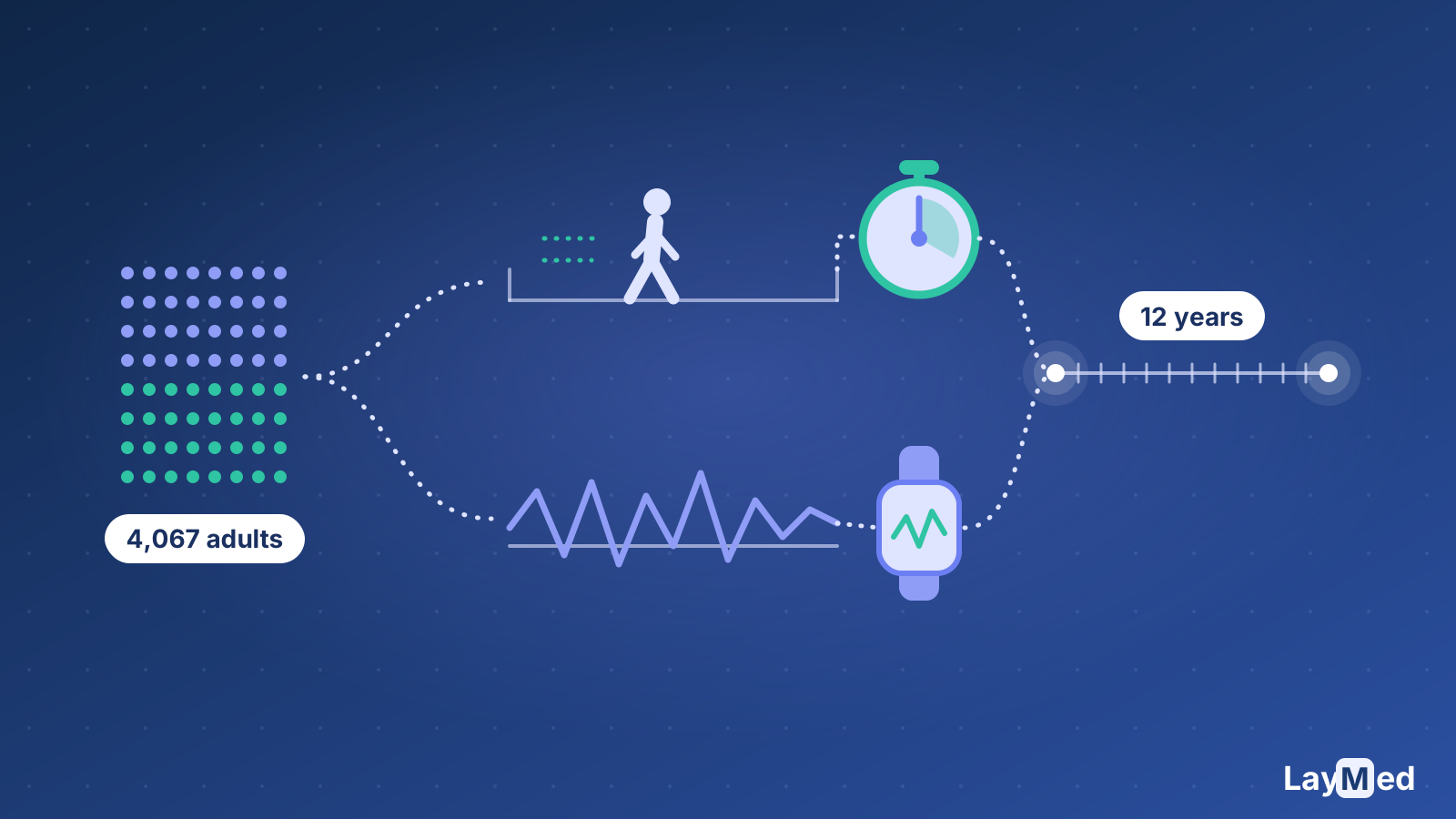
The study used a long-running British health study of civil servants. In 2012 and 2013, 4,067 people with an average age of 69 did two things:
- A timed walk: they walked a 2.44-meter course at their usual pace three times, and a nurse averaged the times.
- A wrist tracker: they wore it for 9 days. From it the researchers worked out each person's typical step rate while walking, and their fastest everyday step rate.
The researchers then followed national death records for about 12 years. They compared how long faster and slower walkers lived, taking into account age, sex, education, smoking, alcohol, diet, body weight, blood pressure, existing diseases and other factors.
Lower risk of death for each step up in pace
People who walked faster lived longer, and this was true whichever way their pace was measured.
Over 12 years, 739 people (18.2%) died. For each step up in pace, the risk of death was lower:
- Clinic walking speed: 23% lower for each 0.3 meters per second faster
- Typical everyday step rate: 17% lower for each 10 steps a minute faster
- Fastest everyday step rate: 18% lower for each 10 steps a minute faster
For reference, the group averaged 1.2 meters per second in the clinic (about 2.7 miles per hour), a typical everyday step rate of 75 steps a minute, and a fastest everyday step rate of 112 steps a minute.
Other findings:
- The clinic test and the wrist tracker were about equally good at telling apart who would and would not die during the study.
- The two measures were only loosely related, so someone who walked fast in the clinic did not always walk fast in daily life.
- The link between step rate and living longer remained after taking daily step count into account.
Conclusion
Adults who walked at a faster pace lived longer over 12 years, whether their pace was timed in a clinic or tracked by a wrist device in daily life.
Therefore
Both a short timed walk and an everyday step rate from a wrist tracker may be useful signs of a person's overall health.
How much can you trust this study?
Two studies can say the same thing and deserve very different amounts of trust. LayMed scores every study out of 100 on:
- Study design
- Bias Control & Transparency
- Size and precision
- Measurement
LayMed Plus members see the Study Quality score for every study, with the reason behind each part.
Get LayMed Plus$7.99 a month or $79 a year
How far does this apply to you personally?
A study can earn a high quality score and still not apply well to you. How much its results carry over to you can change a lot depending on your sex, age, race or ethnicity, body weight, genes, hormones, blood pressure and resting heart rate, health conditions, medications, activity level, training experience, diet, sleep, smoking and drinking, job and gut bacteria.
Hover over or tap any of these to see a real study where it changed the results.
LayMed Plus members get a personal Relevance score for every study. It weighs all of these factors to estimate how well the results apply to you and your life.
Get LayMed Plus$7.99 a month or $79 a year
Important new studies, explained in plain English, sent straight to your inbox.
Almost done. Please check your email for a confirmation sent from "laymed@dr-gains.com".
Last checked against the source: November 20, 2026
Update November 20, 2026: Written to the LayMed article standard from the full published paper.
LayMed articles are plain-English summaries of published research, written for education. They are not medical advice. Always read the original study and talk to a qualified professional about your own situation.