
Short Walking Breaks From Sitting Lowered Blood Sugar and Insulin After Meals in a Review of 53 Studies
Obesity Reviews May 3, 2026
What the researchers wanted to know
Do short activity breaks during long periods of sitting lower blood sugar and insulin after meals, and does it matter what kind of break you take, how often you take it, or what your body weight and health are?
Why it matters
Many adults sit for most of the day. Big swings in blood sugar and insulin after meals are linked to type 2 diabetes and heart disease. Many small studies had tested activity breaks, but they used different break types and timings, so it was unclear what works best.
After you eat, sugar from the food enters your blood. Your body releases insulin, a hormone that moves that sugar out of the blood and into your cells.
When you sit still for hours, your large leg muscles barely work, so they take up little sugar. When muscles contract, even during a slow walk, they pull sugar out of the blood on their own.
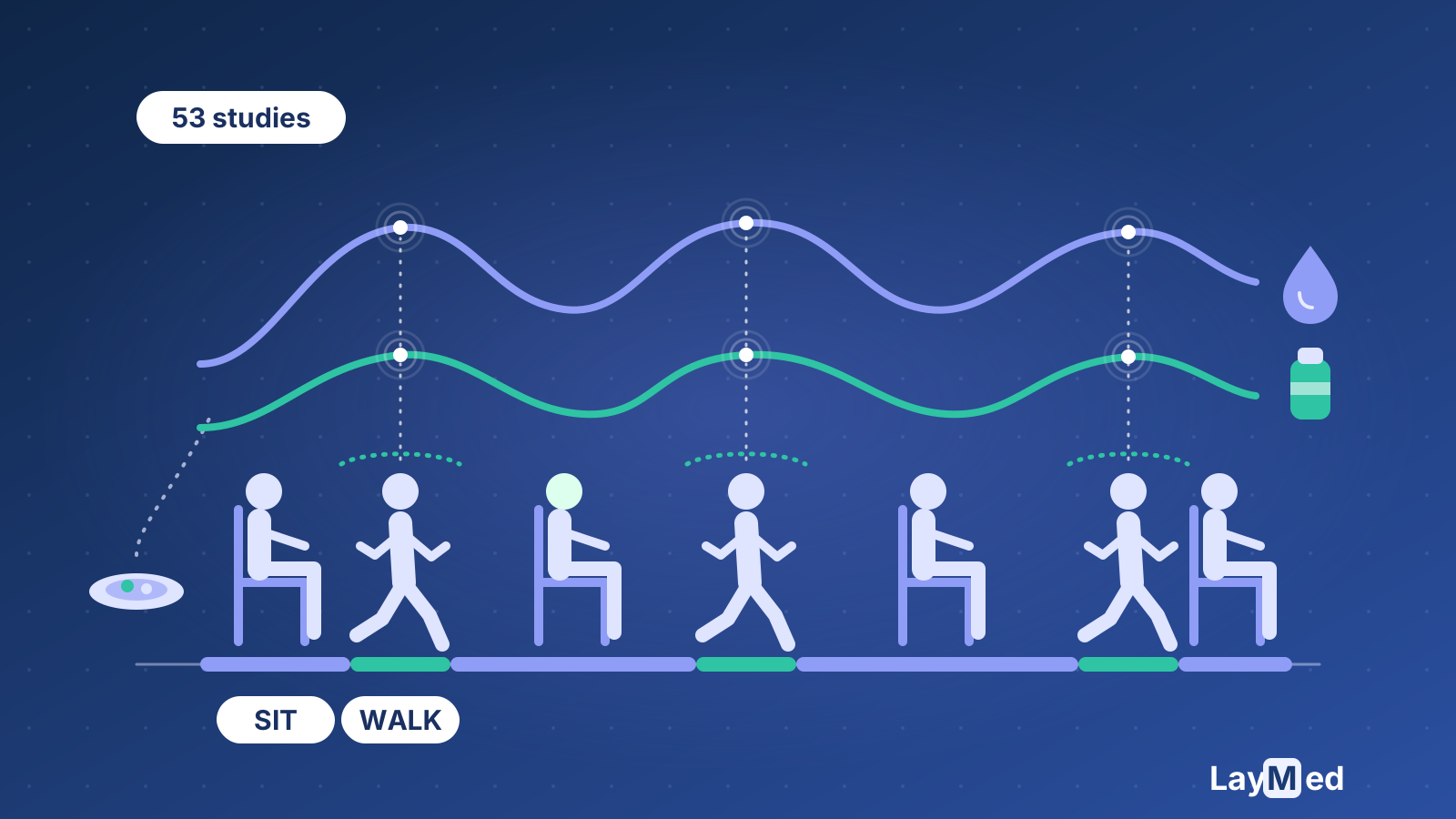
An activity break in these studies meant getting up for 10 minutes or less, at least once an hour, to walk, stand, or do simple strength moves such as chair squats.
The researchers searched five research databases up to October 2024 for lab studies in adults that met these rules:
- Each person did both versions on different days, in random order: one day of sitting the whole time, and one day of the same sitting broken up by short activity breaks.
- Each test day lasted at least 3 hours and included at least one meal.
- Blood sugar, insulin or both were measured repeatedly.
53 studies qualified, and 39 had numbers that could be combined. A typical study had 14 people, broke up sitting every 30 minutes with a 2.5-minute break, and lasted 6.5 hours. Walking was by far the most tested break (35 setups), followed by strength moves (13) and standing (6).
The researchers also rated the quality of every study.
Drop in blood sugar after meals, by how often people got up (bigger = better)
Breaking up sitting lowered both blood sugar and insulin after meals. Walking breaks and more frequent breaks worked best.
The size of each drop is given as an effect size. As a guide, 0.2 is small, 0.5 is medium and 0.8 is large.
- Overall: blood sugar dropped by 0.30 and insulin by 0.30
- Walking breaks: blood sugar 0.33, insulin 0.44
- Strength-move breaks: blood sugar 0.28 and insulin 0.21, but the results were too spread out to be sure of any effect
- Standing breaks: blood sugar 0.08, with too few studies (2) to be sure of any effect
How often people got up:
- Every 15 to 20 minutes: blood sugar 0.51, insulin 0.41
- Every 30 minutes: blood sugar 0.30, insulin 0.28
- Every 45 to 60 minutes: blood sugar 0.20 and insulin 0.17, not clearly different from sitting the whole time
By body weight, the drop in blood sugar was 0.34 in studies of overweight adults and 0.52 in studies of adults with obesity, though with only 3 studies the obesity result was not certain. The two studies of healthy-weight adults showed no drop.
Results differed a lot from one study to the next. Most studies were rated good or fair in quality, and none poor.
Conclusion
Getting up for a short walk every 20 to 30 minutes during long periods of sitting lowers blood sugar and insulin after meals.
Therefore
Regular walking breaks could be a simple way to improve how the body handles meals for people who sit for long stretches, and they may help most in people with a higher body weight.
How much can you trust this study?
Two studies can say the same thing and deserve very different amounts of trust. LayMed scores every study out of 100 on:
- Study design
- Bias Control & Transparency
- Size and precision
- Measurement
LayMed Plus members see the Study Quality score for every study, with the reason behind each part.
Get LayMed Plus$7.99 a month or $79 a year
How far does this apply to you personally?
A study can earn a high quality score and still not apply well to you. How much its results carry over to you can change a lot depending on your sex, age, race or ethnicity, body weight, genes, hormones, blood pressure and resting heart rate, health conditions, medications, activity level, training experience, diet, sleep, smoking and drinking, job and gut bacteria.
Hover over or tap any of these to see a real study where it changed the results.
LayMed Plus members get a personal Relevance score for every study. It weighs all of these factors to estimate how well the results apply to you and your life.
Get LayMed Plus$7.99 a month or $79 a year
Important new studies, explained in plain English, sent straight to your inbox.
Almost done. Please check your email for a confirmation sent from "laymed@dr-gains.com".
Last checked against the source: November 20, 2026
Update November 20, 2026: Written to the LayMed article standard from the full published paper.
LayMed articles are plain-English summaries of published research, written for education. They are not medical advice. Always read the original study and talk to a qualified professional about your own situation.