
Training Muscles in a Stretched Position Built More Muscle Than Training Them in a Shortened Position in a Review of 8 Studies
Original study: Does longer-muscle length resistance training cause greater longitudinal growth in humans? A systematic review
Sports Medicine and Health Science March 6, 2025
What the researchers wanted to know
Does weight training with a muscle in a stretched position make it grow more, and grow longer, than training with it in a shortened position?
Why it matters
Lifters argue over how deep to go on each rep, and half reps done in the stretched part of a lift have become popular. A muscle can grow by getting thicker or by its fibers getting longer, and it was unclear which of these stretched-position training changes.
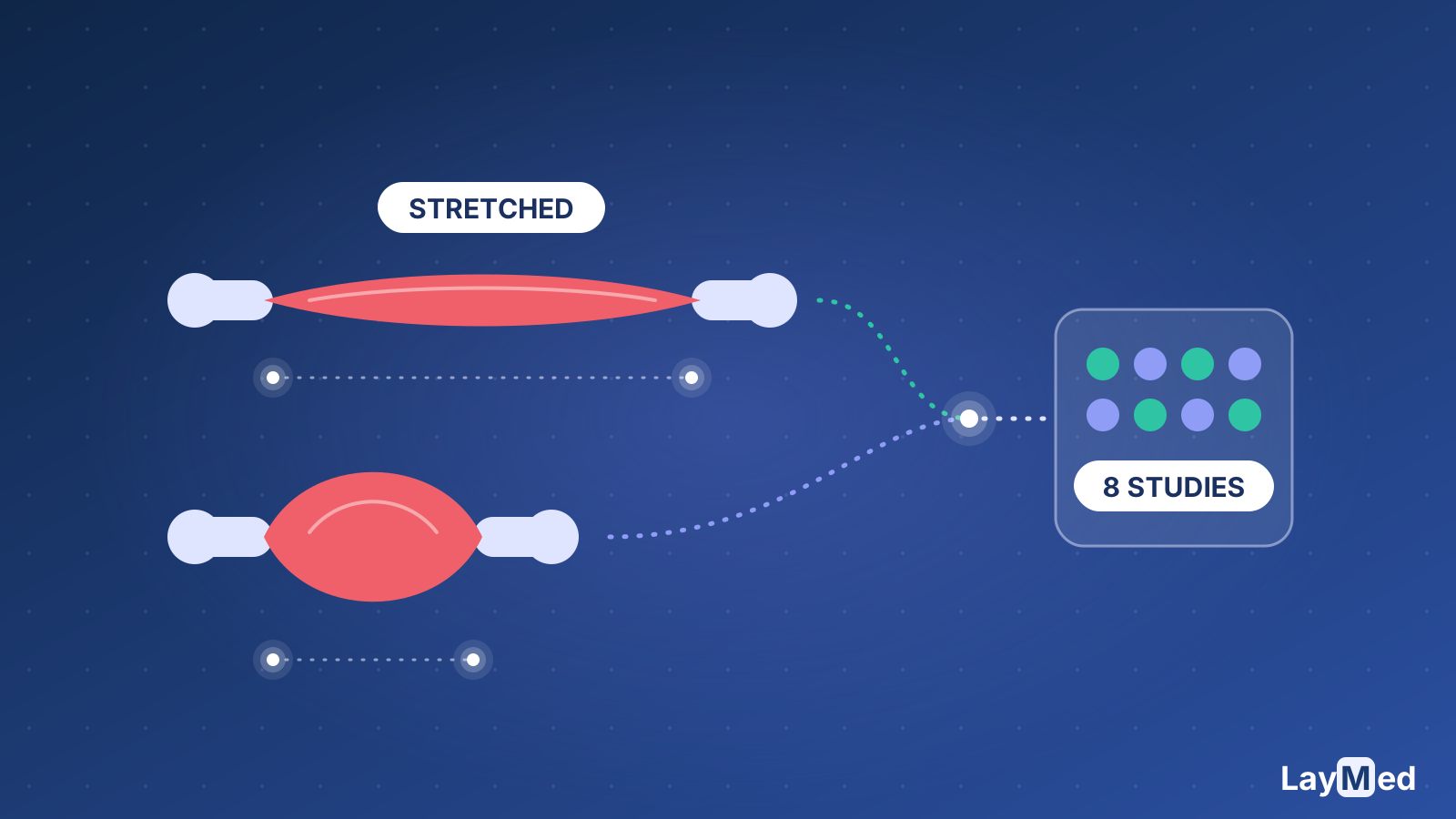
A muscle is at a long length when it is stretched, such as the front of the thigh at the bottom of a squat. It is at a short length when it is bunched up, such as the same muscle when you stand tall.
Muscle fibers are arranged in bundles. Researchers measure the length of these bundles with ultrasound as a sign that the muscle has grown longer. In most studies this length is estimated, and the estimate is not very accurate.
The researchers searched three research databases in February 2024 for training studies that:
- compared training at a long muscle length with training at a short muscle length
- measured both muscle size and fiber-bundle length before and after
- lasted at least 4 weeks and used healthy adults
They found 8 studies with 120 people. Six trained the front of the thigh, one the back of the upper arm and one the shin. Some used normal lifting. Others used holds against a fixed resistance.
The studies were too different to combine into one number, so the results were described and compared. The plan was registered in advance.
Studies by which training built more muscle (out of 8)
Muscle growth was usually larger after training at a long muscle length.
- 4 of the 8 studies found clearly more growth with long-length training. In one, mid-thigh muscle thickness rose 12.8% against 4.5%.
- The other 4 found similar growth with both, or a slight lean toward long-length training.
- No study found clearly more overall growth with short-length training.
Fiber-bundle length also tended to increase more with long-length training. The results were mixed, and all but one study used the less accurate estimating method.
Conclusion
Weight training at longer muscle lengths produced more muscle growth than training at shorter lengths, and may also lengthen muscle fibers more.
Therefore
People who want to build muscle may gain more by emphasizing the stretched part of each exercise.
How much can you trust this study?
Two studies can say the same thing and deserve very different amounts of trust. LayMed scores every study out of 100 on:
- Study design
- Bias Control & Transparency
- Size and precision
- Measurement
LayMed Plus members see the Study Quality score for every study, with the reason behind each part.
Get LayMed Plus$7.99 a month or $79 a year
How far does this apply to you personally?
A study can earn a high quality score and still not apply well to you. How much its results carry over to you can change a lot depending on your sex, age, race or ethnicity, body weight, genes, hormones, blood pressure and resting heart rate, health conditions, medications, activity level, training experience, diet, sleep, smoking and drinking, job and gut bacteria.
Hover over or tap any of these to see a real study where it changed the results.
LayMed Plus members get a personal Relevance score for every study. It weighs all of these factors to estimate how well the results apply to you and your life.
Get LayMed Plus$7.99 a month or $79 a year
Important new studies, explained in plain English, sent straight to your inbox.
Almost done. Please check your email for a confirmation sent from "laymed@dr-gains.com".
Last checked against the source: November 20, 2026
Update November 20, 2026: Written to the LayMed article standard from the full published paper.
LayMed articles are plain-English summaries of published research, written for education. They are not medical advice. Always read the original study and talk to a qualified professional about your own situation.