
Eating Less Protein Made Mice, Rats and Flies Live Longer and Improved Blood Sugar in Short Human Trials, a Review Found
Original study: The hallmarks of protein and amino acid restriction in aging and longevity
Cell Press Blue August 17, 2026
What the researchers wanted to know
What does eating less protein, or less of certain building blocks of protein, do to aging and lifespan, and how does it work inside the body?
Why it matters
Older adults are widely told to eat more protein, and 61% of Americans raised their protein intake in 2024. Yet animal experiments keep finding that eating less protein leads to longer, healthier lives. The two messages point in opposite directions.
Protein is made of smaller units called amino acids. Nine of them must come from food.
Current protein advice, per kilogram of body weight per day:
- 0.8 g: the official minimum recommendation
- 1.0 to 1.2 g: often advised after age 65 to protect muscle
- 1.2 to 1.6 g: the newest US dietary guidelines
Protein restriction means eating less protein while still meeting basic needs. It does not mean eating fewer calories.
This is a narrative review. Two researchers summarized earlier studies and gave their interpretation. They did not run a new experiment.
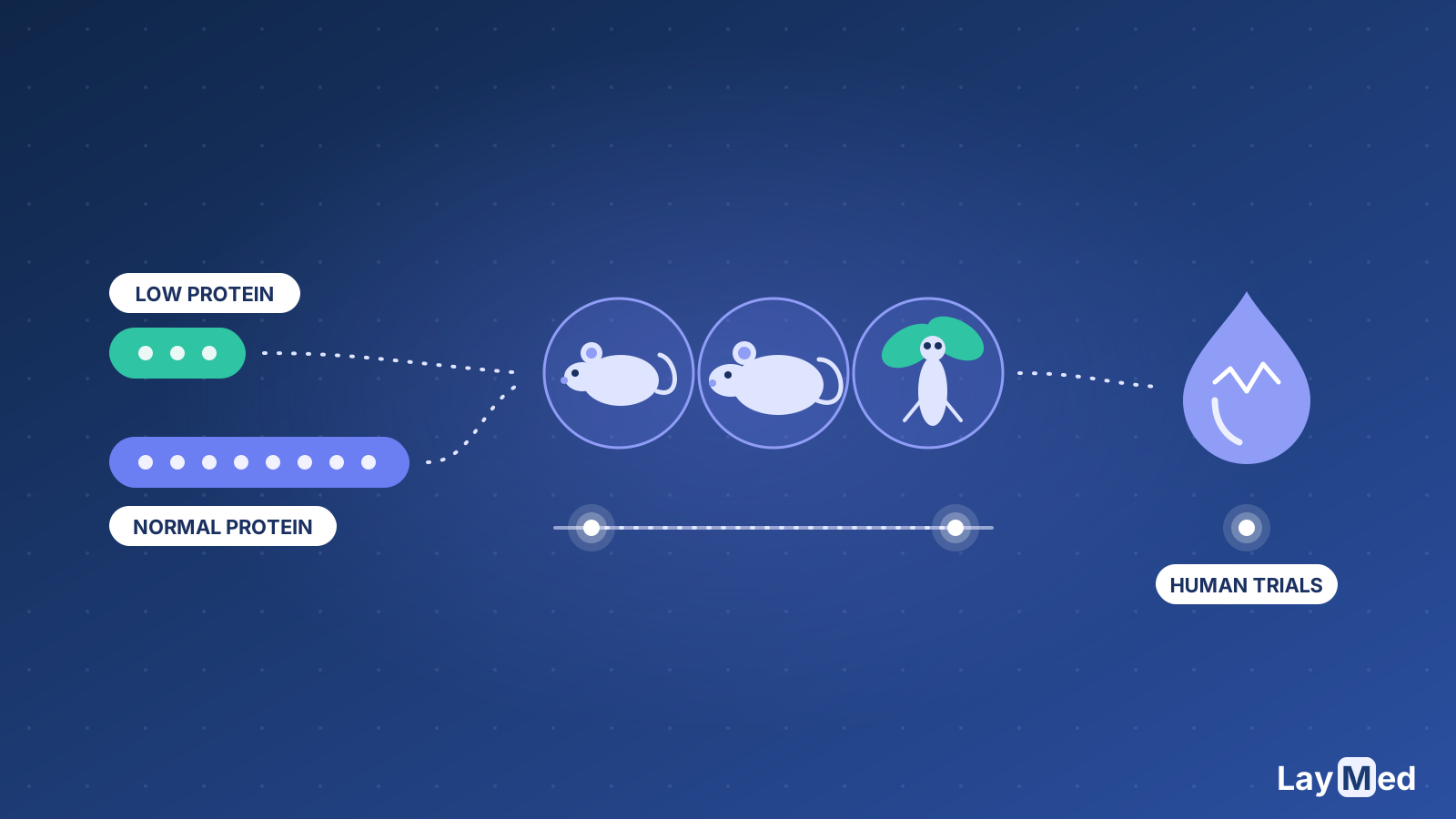
- Most of the evidence comes from lifespan experiments in mice, rats and flies, including many from the authors' own laboratory.
- They also describe human diet trials lasting 27 to 43 days, and large studies that tracked what people ate and how their health turned out.
The paper does not describe how studies were searched for or chosen.
The authors group the effects into six "hallmarks": metabolic health, nutrient-sensing signals, worn-out cells, the energy-producing parts of cells, gene switches, and healthy aging.
Longer lifespan in male mice when this was cut from the diet (%)
In animals, eating less protein extended lifespan.
- In mice and rats, low-protein diets extended lifespan by about 10% to 50% across the experiments listed.
- Cutting only certain amino acids did much the same. In male mice, cutting isoleucine extended lifespan by 33% and cutting valine by 23%.
- Results differed by sex. In one experiment, male mice lived 35% longer on low protein, while females lived 22% shorter.
In people, the evidence is short-term and mixed.
- In trials of 4 to 6 weeks, low-protein diets lowered body fat and fasting blood sugar and improved how well insulin worked.
- Some large studies linked high protein intake to more diabetes, cancer and early death.
- Other studies found the opposite for muscle. Adults eating 1.2 g per kg lost 40% less muscle over 3 years than those eating 0.8 g.
No study has tested whether eating less protein makes people live longer.
Conclusion
Eating less protein, or less of specific amino acids, extended lifespan in laboratory animals and improved blood sugar and body fat in short human trials.
Therefore
People who already eat far more protein than the minimum may not gain a longevity benefit from adding more, while older adults who eat little, pregnant women, people who are dieting and people recovering from injury could be harmed by cutting it.
How much can you trust this study?
Two studies can say the same thing and deserve very different amounts of trust. LayMed scores every study out of 100 on:
- Study design
- Bias Control & Transparency
- Size and precision
- Measurement
LayMed Plus members see the Study Quality score for every study, with the reason behind each part.
Get LayMed Plus$7.99 a month or $79 a year
How far does this apply to you personally?
A study can earn a high quality score and still not apply well to you. How much its results carry over to you can change a lot depending on your sex, age, race or ethnicity, body weight, genes, hormones, blood pressure and resting heart rate, health conditions, medications, activity level, training experience, diet, sleep, smoking and drinking, job and gut bacteria.
Hover over or tap any of these to see a real study where it changed the results.
LayMed Plus members get a personal Relevance score for every study. It weighs all of these factors to estimate how well the results apply to you and your life.
Get LayMed Plus$7.99 a month or $79 a year
Important new studies, explained in plain English, sent straight to your inbox.
Almost done. Please check your email for a confirmation sent from "laymed@dr-gains.com".
Last checked against the source: November 20, 2026
Update November 20, 2026: Written to the LayMed article standard from the full published paper.
LayMed articles are plain-English summaries of published research, written for education. They are not medical advice. Always read the original study and talk to a qualified professional about your own situation.