
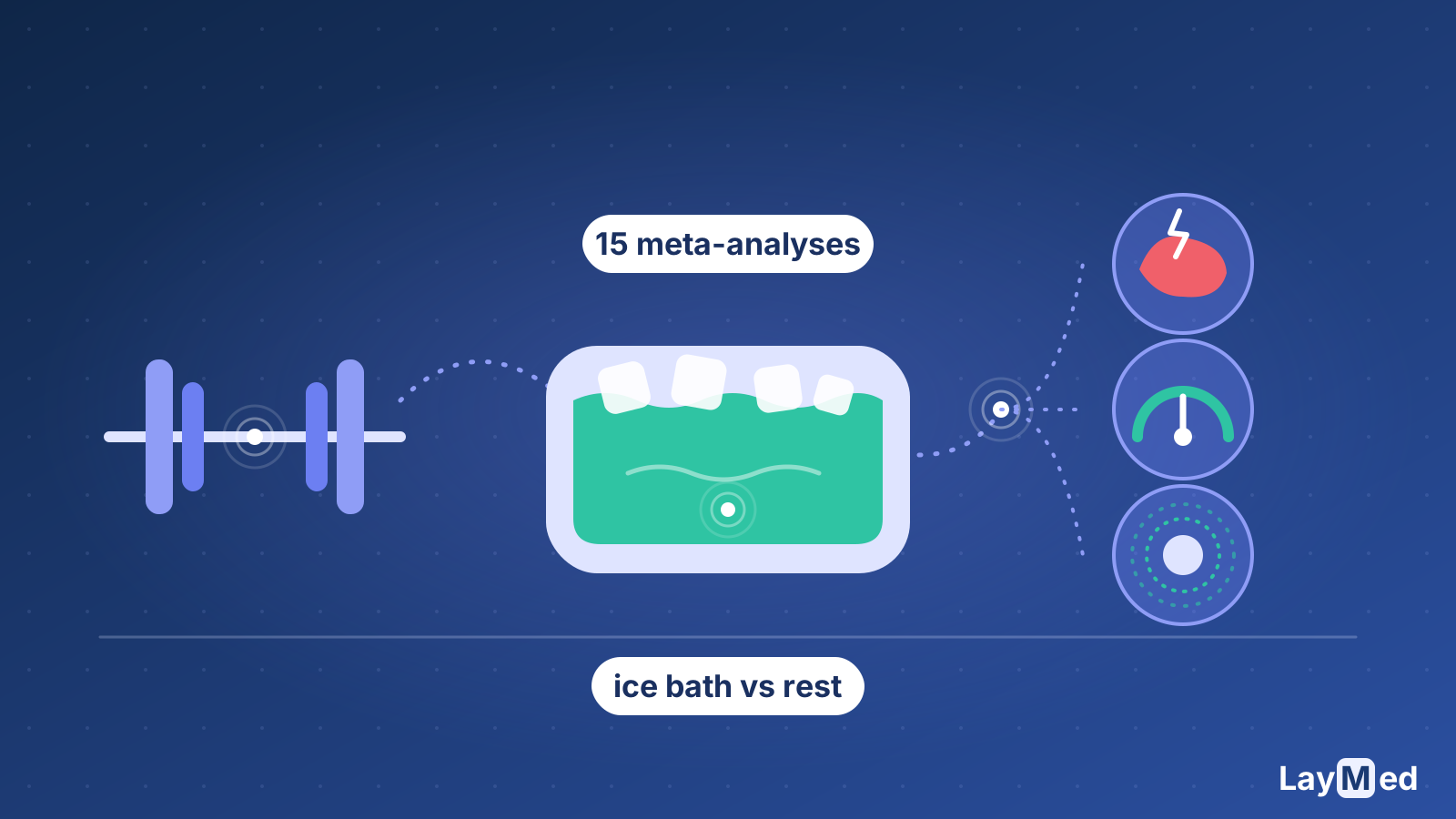
Ice Baths After Exercise Eased Soreness but Reduced Strength and Muscle Gains in a Review of 15 Meta-Analyses
Sports Medicine - Open September 30, 2026
What the researchers wanted to know
When does an ice bath after exercise help recovery and performance, and when does it get in the way of the gains from training?
Why it matters
Ice baths and cold plunges are widely used after workouts. Fifteen reviews had combined the trials, but each looked at different outcomes and they did not all agree. Nobody had put them together into one picture.
A cold-water immersion, or ice bath, means sitting in cold water after exercise, usually for 5 to 15 minutes.
Training makes you fitter because the body adapts to the stress of each session. Anything that dampens that stress response could also dampen the gains.
Results here are given as an effect size, a standard number for comparing different tests. About 0.2 is small, 0.5 is medium and 0.8 is large.
This is a review of reviews. The researchers searched eight research databases for reviews that had combined randomized trials of ice baths after exercise in healthy people.
- They found 15 reviews, published from 2011 to 2025, covering 161 separate trials.
- Ice baths were compared with resting or with other recovery methods.
- Each review was rated for quality, and each finding for how certain it is.
- They checked how much the reviews relied on the same trials.
The plan was registered in advance.
How much regular ice baths cut training gains (effect size)
Ice baths helped short-term recovery but reduced the gains from weight training.
Recovery after a hard session:
- Muscle soreness was lower right away and for the next 1 to 3 days.
- Muscle power and jump height were better 24 to 48 hours later.
- Jump height was worse in the first few hours after the bath.
- Baths of 10 to 15 minutes at 5 to 15 °C worked best.
Used regularly over weeks of training:
- Strength gains were smaller, mainly when only the trained limbs were put in the water (effect size 0.31). Whole-body baths showed no clear effect (0.08).
- Muscle growth was slightly smaller (effect size 0.22).
- Endurance gains were unchanged.
All 15 reviews were rated low or critically low in quality, and the findings were graded low to very low in certainty.
Conclusion
Ice baths after exercise reduced soreness and helped next-day power, and regular use after weight training reduced strength and muscle gains.
Therefore
Ice baths may be best saved for times when fast recovery matters more than building strength or muscle, such as tournaments and back-to-back hard days.
How much can you trust this study?
Two studies can say the same thing and deserve very different amounts of trust. LayMed scores every study out of 100 on:
- Study design
- Bias Control & Transparency
- Size and precision
- Measurement
LayMed Plus members see the Study Quality score for every study, with the reason behind each part.
Get LayMed Plus$7.99 a month or $79 a year
How far does this apply to you personally?
A study can earn a high quality score and still not apply well to you. How much its results carry over to you can change a lot depending on your sex, age, race or ethnicity, body weight, genes, hormones, blood pressure and resting heart rate, health conditions, medications, activity level, training experience, diet, sleep, smoking and drinking, job and gut bacteria.
Hover over or tap any of these to see a real study where it changed the results.
LayMed Plus members get a personal Relevance score for every study. It weighs all of these factors to estimate how well the results apply to you and your life.
Get LayMed Plus$7.99 a month or $79 a year
Important new studies, explained in plain English, sent straight to your inbox.
Almost done. Please check your email for a confirmation sent from "laymed@dr-gains.com".
Last checked against the source: November 20, 2026
Update November 20, 2026: Written to the LayMed article standard from the full published paper.
LayMed articles are plain-English summaries of published research, written for education. They are not medical advice. Always read the original study and talk to a qualified professional about your own situation.