
Adding Carbs to a Daily Protein Shake Did Not Increase Muscle or Strength Gains in an 8-Week Trial of 20 Trained Men
Original study: Effects of Modest Carbohydrate–Energy Supplementation on Resistance Training Adaptations in Trained Men: A Crossover Trial
Nutrients June 17, 2026
What the researchers wanted to know
Does eating extra carbohydrate and calories each day lead to more muscle and strength from weight training in experienced lifters?
Why it matters
Many lifters eat extra calories and carbohydrate in the belief that it builds muscle faster. Earlier studies gave mixed answers, and many could not separate the effect of extra calories from the effect of extra protein.
Carbohydrate is the body's main fuel for hard exercise. The idea is that more fuel allows more training, and that extra calories help the body build new tissue.
In a crossover trial, every person tries both options, one after the other. Each person is compared with himself, which helps when a study is small.
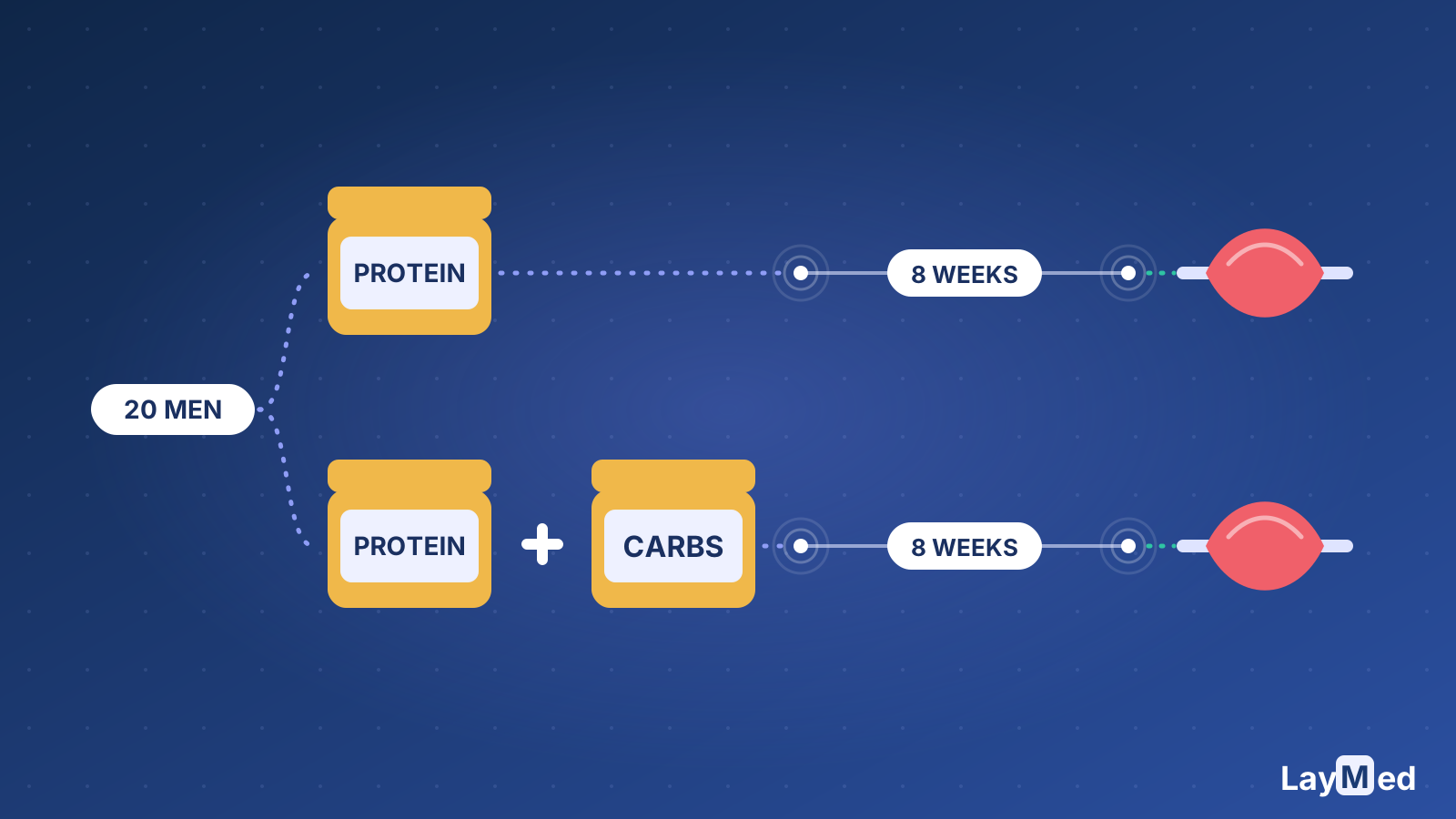
The researchers gave 20 experienced lifters two daily supplements, each for 8 weeks, in a set order that balanced who started with which.
- Protein only: 30 g of protein with 4 g of carbohydrate
- Protein plus carbohydrate: 30 g of protein with 54 g of carbohydrate
Neither the men nor the testers knew which supplement was which. The men kept their usual training and diet and logged their food.
Before and after each 8 weeks, the researchers measured lean mass by body scan, thigh muscle size by ultrasound, the heaviest squat each man could lift once, and leg strength and fatigue on a machine.
The extra carbohydrate did not improve any measure of muscle or strength.
On the carbohydrate supplement, the men ate more each day:
- 485 more calories
- 33 g more carbohydrate
Protein and fat intake and the amount of training were the same in both phases.
- Lean mass, thigh muscle size, squat strength and leg strength did not differ between the two phases.
- Thigh muscle size and peak leg strength leaned slightly toward the protein-only phase.
- Resistance to fatigue leaned slightly toward the carbohydrate phase. The difference was not large enough to be sure of.
The results were not precise enough to rule out a small effect in either direction.
Conclusion
Adding about 500 calories and extra carbohydrate a day did not increase muscle growth or strength over 8 weeks in experienced male lifters.
Therefore
Experienced lifters who already eat enough protein may not gain muscle faster by adding extra carbohydrate and calories.
How much can you trust this study?
Two studies can say the same thing and deserve very different amounts of trust. LayMed scores every study out of 100 on:
- Study design
- Bias Control & Transparency
- Size and precision
- Measurement
LayMed Plus members see the Study Quality score for every study, with the reason behind each part.
Get LayMed Plus$7.99 a month or $79 a year
How far does this apply to you personally?
A study can earn a high quality score and still not apply well to you. How much its results carry over to you can change a lot depending on your sex, age, race or ethnicity, body weight, genes, hormones, blood pressure and resting heart rate, health conditions, medications, activity level, training experience, diet, sleep, smoking and drinking, job and gut bacteria.
Hover over or tap any of these to see a real study where it changed the results.
LayMed Plus members get a personal Relevance score for every study. It weighs all of these factors to estimate how well the results apply to you and your life.
Get LayMed Plus$7.99 a month or $79 a year
Important new studies, explained in plain English, sent straight to your inbox.
Almost done. Please check your email for a confirmation sent from "laymed@dr-gains.com".
Last checked against the source: November 20, 2026
Update November 20, 2026: Written to the LayMed article standard from the full published paper.
LayMed articles are plain-English summaries of published research, written for education. They are not medical advice. Always read the original study and talk to a qualified professional about your own situation.