
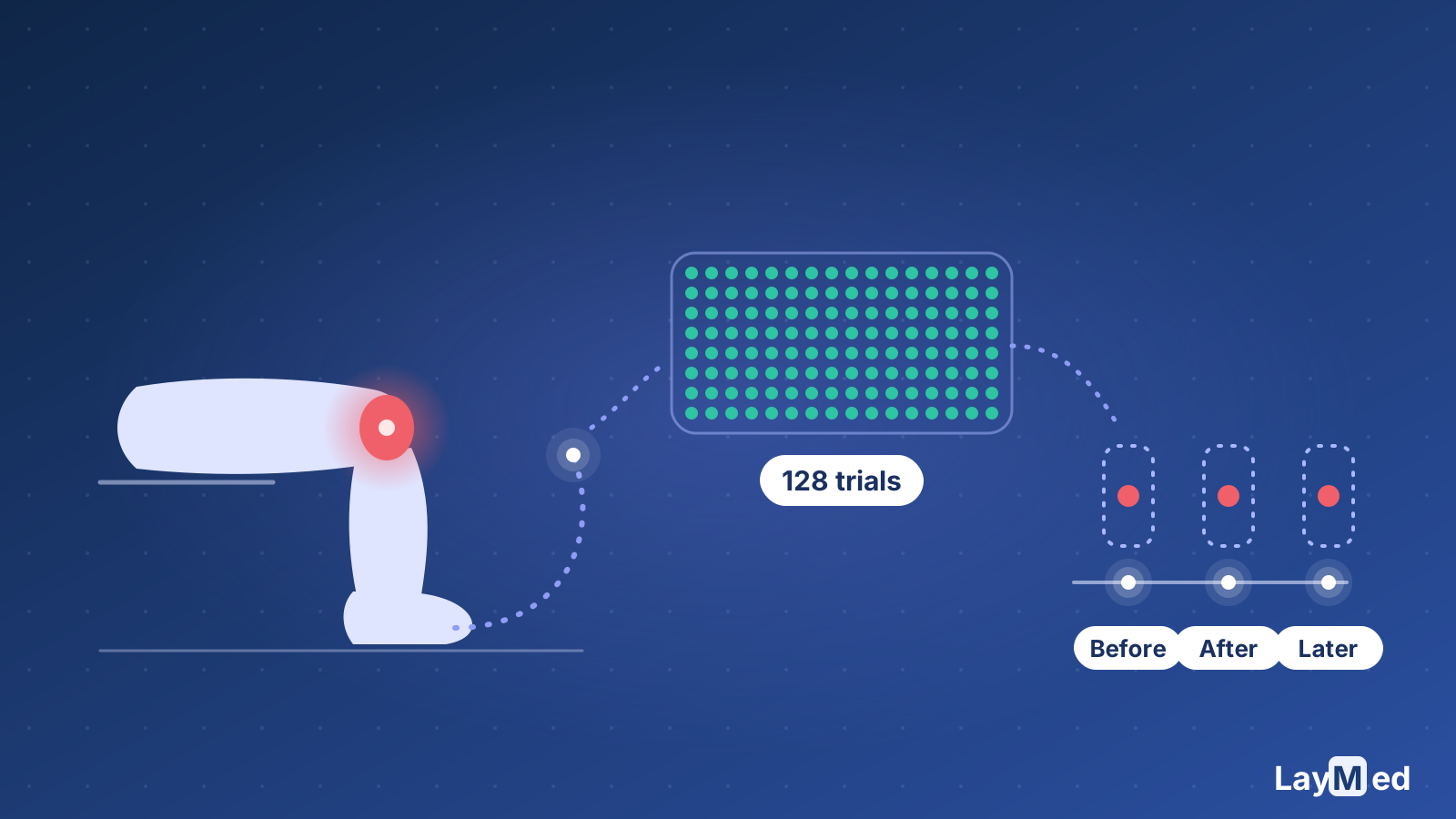
Exercise Eased Knee Arthritis Pain Only Slightly and Briefly in a Review of 128 Trials
Original study: Effectiveness of exercise therapy for osteoarthritis: an overview of systematic reviews and randomised controlled trials
RMD Open February 17, 2026
What the researchers wanted to know
How much does exercise reduce pain and improve physical function in people with osteoarthritis, compared with a sham treatment, with doing nothing, and with other treatments such as education, painkillers, injections and surgery?
Why it matters
Exercise is recommended worldwide as the first treatment for osteoarthritis. Yet some recent studies suggest its benefits have been overestimated. There were many reviews on the topic, but no single one set exercise side by side with all the alternatives.
Osteoarthritis is the most common joint disease. The cushioning cartilage in a joint wears down and the joint becomes painful and stiff. It mostly affects the knees, hips and hands.
In these studies, pain is usually scored by the patient on a scale from 0 to 100, where 0 is no pain and 100 is the worst pain. A change of about 10 is generally seen as small, and many patients do not find it worth the effort.
A sham treatment looks like a real treatment but has no active part. Comparing against it shows how much of an improvement comes from the treatment itself and how much from simply being cared for.
The researchers searched five research databases up to November 2025.
- They chose the 5 most complete and up-to-date reviews, covering 100 trials and 8,631 people.
- They added 28 newer or missing trials with 4,360 people, to cover comparisons the reviews had left out.
All trials had randomly assigned people to exercise or to something else. Two researchers independently pulled out the data and rated each trial for bias. Every pain and function result was converted to the same 0 to 100 scale and the numbers were combined again from scratch.
Each finding was then graded for how certain it is.
Pain relief from exercise (points on a 0 to 100 scale)
Exercise reduced arthritis pain a little in the short term, and no more than most other treatments.
Pain reduction from exercise, on a 0 to 100 scale:
- Knee, against a sham treatment: 10.8 points
- Knee, against no treatment: 12.4 points
- Hip: 6.7 points
- Hand: 10.0 points
The knee results were graded as very uncertain, and the benefit was smaller in larger trials and in trials that followed people for longer.
Against other treatments:
- Exercise did about the same as patient education, hands-on therapy, painkillers, joint injections and keyhole knee surgery.
- In single trials of selected patients, exercise did worse over the longer term than bone-realigning knee surgery (by 12.4 points), knee replacement (by 17.1 points) and hip replacement (by 24.2 points).
Conclusion
Exercise for osteoarthritis appears to bring small, short-lasting reductions in pain that are similar to, or smaller than, those of other treatments.
Therefore
Patients and clinicians may want to weigh whether the pain relief from exercise is worth it for them, alongside its other health benefits, its safety and low cost, and the other treatment options.
How much can you trust this study?
Two studies can say the same thing and deserve very different amounts of trust. LayMed scores every study out of 100 on:
- Study design
- Bias Control & Transparency
- Size and precision
- Measurement
LayMed Plus members see the Study Quality score for every study, with the reason behind each part.
Get LayMed Plus$7.99 a month or $79 a year
How far does this apply to you personally?
A study can earn a high quality score and still not apply well to you. How much its results carry over to you can change a lot depending on your sex, age, race or ethnicity, body weight, genes, hormones, blood pressure and resting heart rate, health conditions, medications, activity level, training experience, diet, sleep, smoking and drinking, job and gut bacteria.
Hover over or tap any of these to see a real study where it changed the results.
LayMed Plus members get a personal Relevance score for every study. It weighs all of these factors to estimate how well the results apply to you and your life.
Get LayMed Plus$7.99 a month or $79 a year
Important new studies, explained in plain English, sent straight to your inbox.
Almost done. Please check your email for a confirmation sent from "laymed@dr-gains.com".
Last checked against the source: November 20, 2026
Update November 20, 2026: Written to the LayMed article standard from the full published paper.
LayMed articles are plain-English summaries of published research, written for education. They are not medical advice. Always read the original study and talk to a qualified professional about your own situation.