
Exercise Raised Bone Density in the Lower Spine and Hip in a Review of 12 Trials in Middle-Aged and Older Men
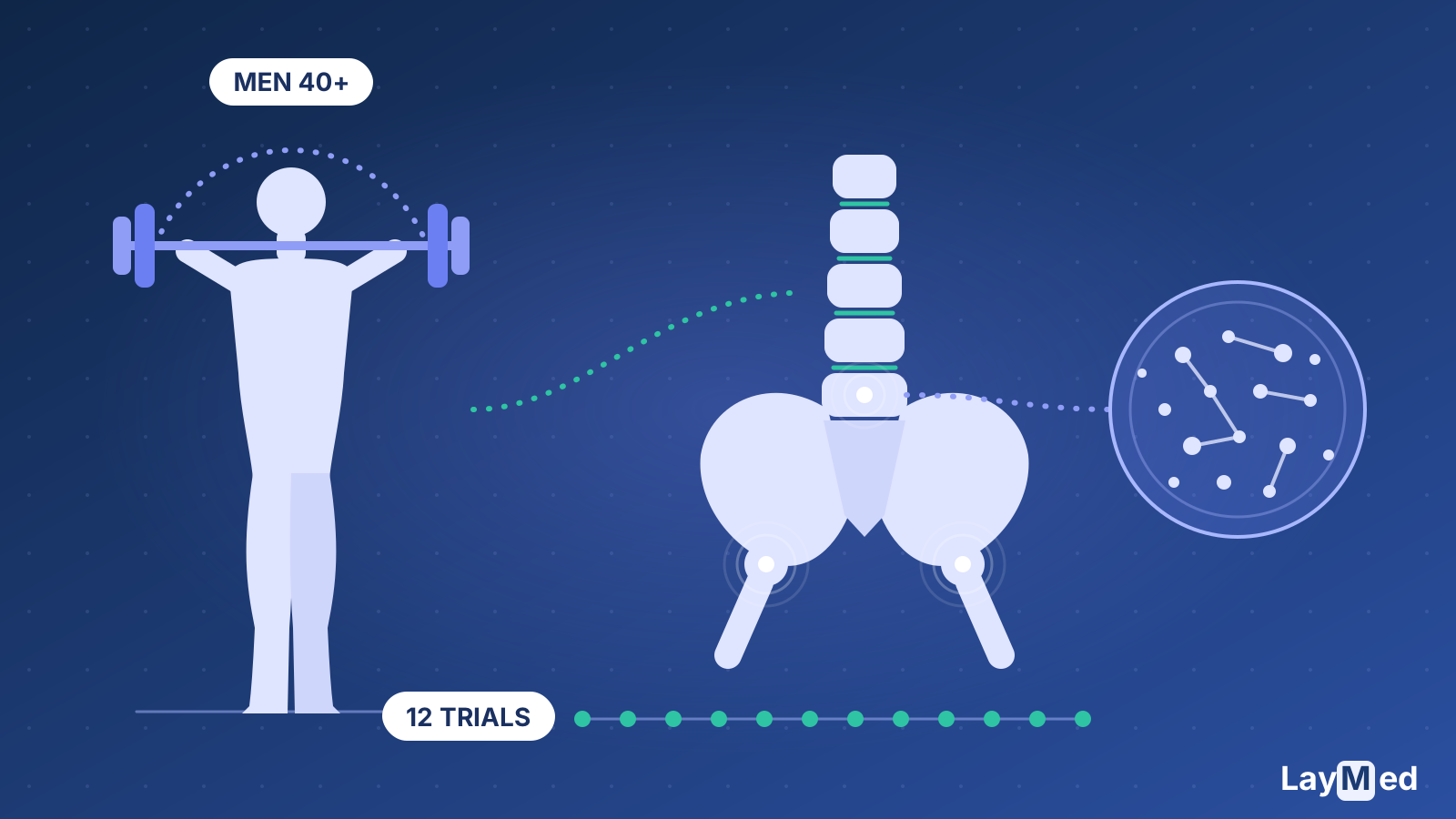
Original study: The effects of exercise interventions on bone mineral density in middle-aged and older men: a systematic review and meta-analysis
Frontiers in Physiology May 29, 2026
What the researchers wanted to know
Does exercise increase bone density in middle-aged and older men, at which parts of the skeleton, and with what kind and amount of exercise?
Why it matters
Weak bones are often thought of as a women's problem, yet about 12% of men worldwide have osteoporosis, and men who break a hip are more likely to die afterwards than women. Most exercise-and-bone research has been done in women, and the results in men have been mixed.
Bone density is how much mineral is packed into a bone. It is measured with a low-dose X-ray scan. Lower density means a higher chance of breaking a bone.
Three places are usually scanned because they break most often and matter most: the lower spine, the whole hip, and the neck of the thigh bone, the narrow part just below the ball of the hip joint.
Bone responds to force. When muscles pull hard on a bone, or the body lands from a jump, bone cells get a signal to build.
The researchers searched three research databases for trials that randomly assigned men to an exercise program or to no program and then measured bone density.
- 12 trials with 1,061 men qualified: 540 in exercise groups and 521 in comparison groups.
- Programs included weight training, impact exercise such as jumping, aerobic exercise, and programs that mixed several kinds.
- Follow-up ran for up to 18 months.
They combined the results for each part of the skeleton, then looked at whether age, the length of the program, sessions per week and the kind of exercise made a difference. The plan was registered in advance, and each trial was rated for quality.
Gain in lower-spine bone density, by type of program (effect size)
Exercise raised bone density in the lower spine and the neck of the thigh bone, but not clearly in the whole hip.
The size of each gain is given as an effect size. As a guide, 0.2 is small and 0.5 is medium.
- Lower spine: 0.13, a clear gain
- Neck of the thigh bone: a clear gain
- Whole hip: 0.08, not a clear gain
What seemed to work best for the lower spine:
- Mixing kinds of exercise: 0.19 for mixed programs, against 0.10 for a single kind
- Longer programs: 0.16 for programs longer than 6 months
- More sessions a week
Men under 65 and men 65 and older responded similarly.
Some trials did not clearly describe how men were assigned to groups, which lowered the certainty of the main results.
Conclusion
Exercise increases bone density in the lower spine and the neck of the thigh bone in middle-aged and older men, with mixed programs kept up for more than 6 months appearing to work best.
Therefore
Exercise could be an effective drug-free way for aging men to strengthen the bones most likely to break.
How much can you trust this study?
Two studies can say the same thing and deserve very different amounts of trust. LayMed scores every study out of 100 on:
- Study design
- Bias Control & Transparency
- Size and precision
- Measurement
LayMed Plus members see the Study Quality score for every study, with the reason behind each part.
Get LayMed Plus$7.99 a month or $79 a year
How far does this apply to you personally?
A study can earn a high quality score and still not apply well to you. How much its results carry over to you can change a lot depending on your sex, age, race or ethnicity, body weight, genes, hormones, blood pressure and resting heart rate, health conditions, medications, activity level, training experience, diet, sleep, smoking and drinking, job and gut bacteria.
Hover over or tap any of these to see a real study where it changed the results.
LayMed Plus members get a personal Relevance score for every study. It weighs all of these factors to estimate how well the results apply to you and your life.
Get LayMed Plus$7.99 a month or $79 a year
Important new studies, explained in plain English, sent straight to your inbox.
Almost done. Please check your email for a confirmation sent from "laymed@dr-gains.com".
Last checked against the source: November 20, 2026
Update November 20, 2026: Written to the LayMed article standard from the full published paper.
LayMed articles are plain-English summaries of published research, written for education. They are not medical advice. Always read the original study and talk to a qualified professional about your own situation.