
Blood Flow Restriction Training After ACL Surgery Improved Thigh Strength in a Review of 9 Trials
Orthopaedic Journal of Sports Medicine July 8, 2026
What the researchers wanted to know
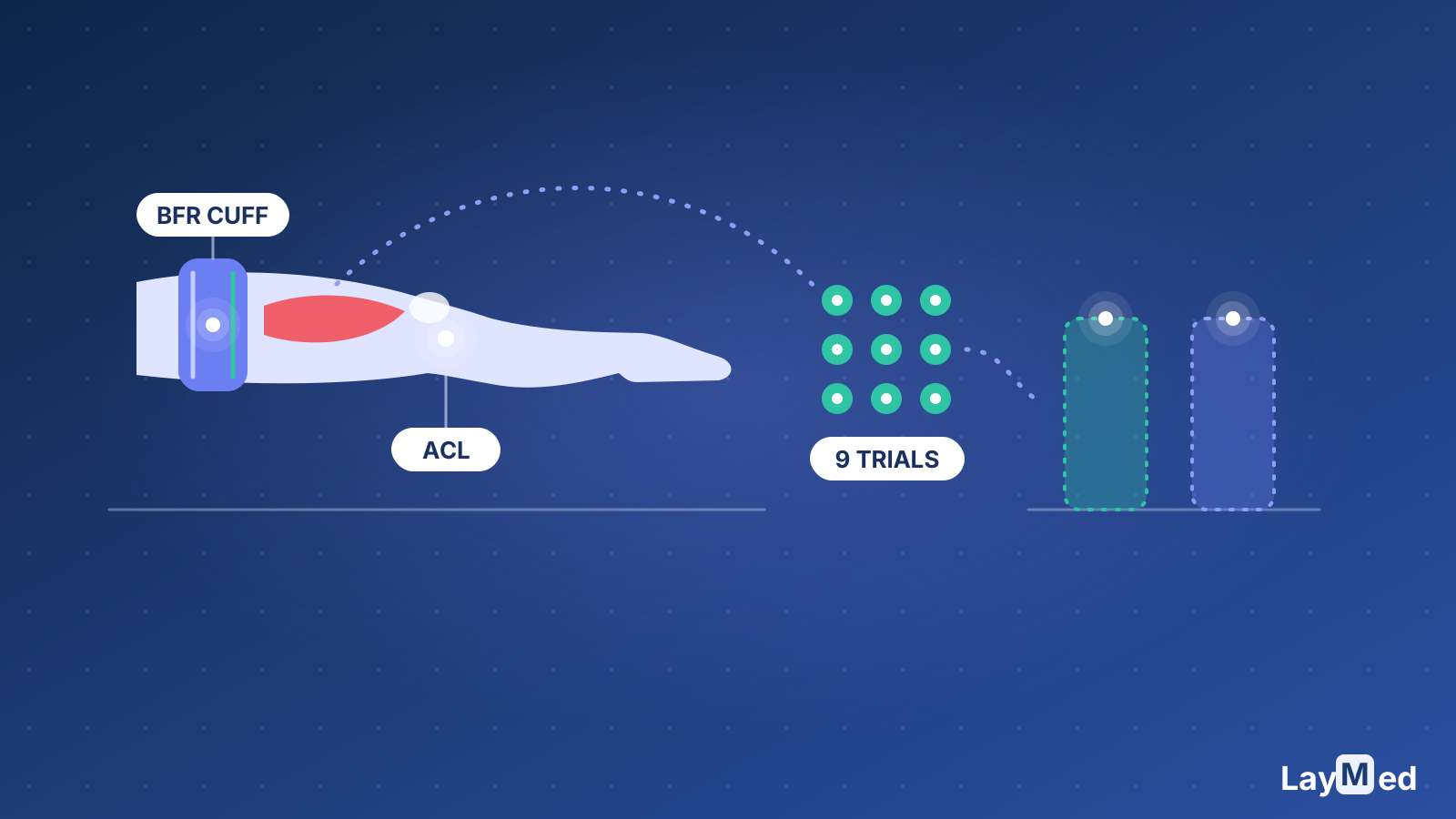
After ACL reconstruction surgery, does adding blood flow restriction to rehab exercises improve thigh strength, knee function and pain more than the same kind of rehab without it?
Why it matters
After ACL surgery the muscle at the front of the thigh shrinks and weakens fast, because pain and the healing graft rule out heavy exercise for months. That weakness can last for years and slows the return to sport. Blood flow restriction is meant to build muscle with light weights, which is exactly what these patients are limited to.
The ACL is a ligament inside the knee that keeps the shin bone from sliding forward. When it tears, surgeons often rebuild it with a piece of tendon. This is ACL reconstruction.
Blood flow restriction training uses a cuff around the top of the limb, inflated enough to slow blood flow while you exercise with light weights. The muscle tires quickly, which seems to trigger growth that normally needs heavy weights.
Knee function after surgery is usually scored with patient questionnaires on a 0 to 100 scale. Thigh strength is measured on a machine that records how hard you can straighten your knee.
The researchers searched seven research databases for trials published from 2015 to August 2025.
- 9 trials with 372 patients qualified.
- In every trial, patients were randomly assigned to rehab with blood flow restriction or to standard rehab without it. In some trials the comparison group did the identical exercises with the cuff not inflated or barely inflated.
- Cuff pressures and exercise programs differed from trial to trial.
The researchers combined the results for thigh strength, two knee function questionnaires, pain and how far the knee could bend and straighten. They rated each trial for bias and checked whether removing any one trial changed the findings.
Blood flow restriction improved thigh strength and one of the two knee function scores. It made no difference to pain or knee movement.
- Thigh strength: greater with blood flow restriction by 8.34 units on the strength machine, a clear difference
- Total work the thigh could do: higher with blood flow restriction
- Knee function, first questionnaire: 5.75 points better on a 100-point scale. The true gain could be anywhere from 0.60 to 10.90 points.
- Knee function, second questionnaire: no difference
- Pain: no difference
- How far the knee moves: no difference
Removing any single trial did not change the main findings. Results for the function scores and knee movement varied a great deal from trial to trial.
The training appeared to be well tolerated, but the trials did not report side effects consistently.
Conclusion
Adding blood flow restriction to light-load rehab after ACL surgery appears to speed the early return of thigh strength, without changing pain or knee movement.
Therefore
Blood flow restriction may be a useful addition to early rehab after ACL surgery, when heavy loading is not yet possible.
How much can you trust this study?
Two studies can say the same thing and deserve very different amounts of trust. LayMed scores every study out of 100 on:
- Study design
- Bias Control & Transparency
- Size and precision
- Measurement
LayMed Plus members see the Study Quality score for every study, with the reason behind each part.
Get LayMed Plus$7.99 a month or $79 a year
How far does this apply to you personally?
A study can earn a high quality score and still not apply well to you. How much its results carry over to you can change a lot depending on your sex, age, race or ethnicity, body weight, genes, hormones, blood pressure and resting heart rate, health conditions, medications, activity level, training experience, diet, sleep, smoking and drinking, job and gut bacteria.
Hover over or tap any of these to see a real study where it changed the results.
LayMed Plus members get a personal Relevance score for every study. It weighs all of these factors to estimate how well the results apply to you and your life.
Get LayMed Plus$7.99 a month or $79 a year
Important new studies, explained in plain English, sent straight to your inbox.
Almost done. Please check your email for a confirmation sent from "laymed@dr-gains.com".
Last checked against the source: November 20, 2026
Update November 20, 2026: Written to the LayMed article standard from the full published paper.
LayMed articles are plain-English summaries of published research, written for education. They are not medical advice. Always read the original study and talk to a qualified professional about your own situation.