Longitudinal Cohort Study >
Human aging doesn’t happen at a constant rate—there are “bursts” around age ~44 and ~60
LayMed Simplified Version
Purpose:
The researchers wanted to see whether the biology of aging changes steadily year-by-year, or whether it shifts more in bursts at certain ages. To do this, they repeatedly measured many different biological markers in the same people over time, using a powerful method called multi-omics.
Importance:
If aging-related biology changes more sharply at certain ages, those windows could be especially important for prevention—because they may be times when disease and injury risk begins to rise faster and the body’s systems start shifting more noticeably.

As people age, the risk of many chronic diseases increases—but it doesn’t always rise at the same speed throughout adulthood. In real life, some health problems become much more common after certain ages, suggesting aging-related changes may not happen in a perfectly smooth, gradual way.
Modern lab tools can measure thousands of biological markers at once (often from blood and other samples). When multiple “omics” layers are measured together—like proteins, metabolites, and the microbiome —it can give a broader picture of how the body is changing over time, instead of relying on just one marker.
Who was studied: 108 adults (ages 25–75) living in California.
How long they were followed: Typically about 1.7 years, with some followed up to 6.8 years.
What they measured repeatedly: Multiple “omics” layers (for example: RNA, proteins, metabolites, cytokines, clinical lab tests, lipids) plus microbiome data from multiple body sites.
How they analyzed it (simple version): They looked for ages where many markers changed at once, and checked whether those patterns stayed consistent when using different reasonable analysis settings.
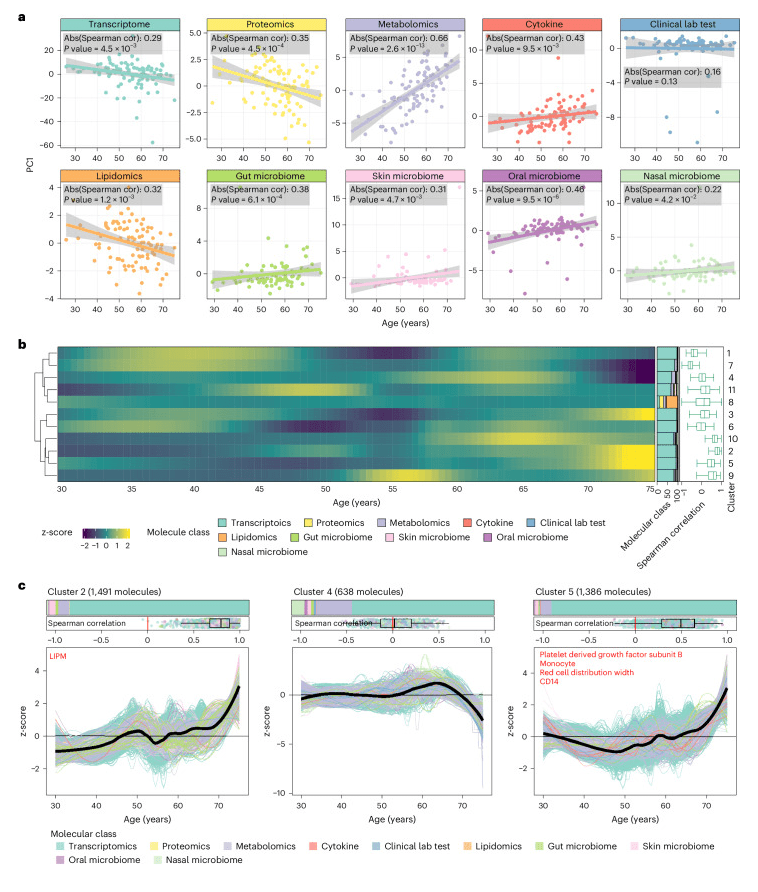
The researchers found that many aging-related biological markers did not change in a straight line over time. Instead, they observed two major “waves” where a large number of markers shifted—around ~44 years and ~60 years.
The ~60-year wave was linked (in their pathway analysis) to changes related to immune regulation and carbohydrate metabolism.
The ~40s wave was linked to changes related to cardiovascular-related biology, lipid metabolism, and alcohol metabolism.
Practical interpretation: this suggests that, at the group level, midlife and early older age may be periods when the body’s molecular patterns shift more noticeably—rather than everything changing at the same pace every year.
Aging-related biology may shift most noticeably right about age 44, and again at about age 60.
This makes them critical windows for prevention and adaptation.
Study Strengths:
• Longitudinal design with repeated measurements in the same people (stronger than one-time “snapshot” studies).
• Very deep multi-omics profiling (hundreds of thousands of features across blood + multiple microbiome sites), which makes the “two-wave” pattern harder to dismiss as a fluke in any one marker type.
• Wide adult age span (25–75 years) and frequent follow-ups (sampled every 3–6 months while healthy).
• Findings highlight two clear transition periods (~44 and ~60) with biologically coherent pathway shifts (e.g., immune regulation, carbohydrate metabolism, lipid/alcohol metabolism).
Potential Weaknesses / Limitations:
• Participants were all from California, which may limit generalizability to other regions, diets, and environments.
• Observational cohort (not a randomized intervention), so it can’t isolate what causes the transitions (lifestyle, environment, medications, etc. could contribute).
Key Figures
Disclaimer: This simplified version is LayMed’s own interpretation of the original article’s text, and may or may not accurately reflect the beliefs, views, or findings of the authors. The article was published in Nature, and the copyright is owned by the authors.
Citation: Shen X, Wang C, Zhou X, Zhou W, Hornburg D, Wu S, Snyder MP. Nonlinear dynamics of multi-omics profiles during human aging. Nat Aging. 2024 Aug 14;4(11):1619-1634. doi:10.1038/s43587-024-00692-2. PMID: 39143318; PMCID: PMC11564093